RESEARCH 001 · WOMEN'S HEART HEALTH · UNITED STATES
Women's heart health.
Does geography matter?
Nearly 12 million women live in 138 counties with higher cardiology density, yet women represent less than 10% of the registered cardiology workforce.
Explore the findings ↓01 / OVERVIEW
From clinical evidence to a geographic question
Who provides care may matter for women's cardiovascular outcomes. In an observational study of patients admitted with acute myocardial infarction to Florida hospital emergency departments, Greenwood, Carnahan and Huang reported higher mortality among female patients treated by male physicians. The study examined treating physicians, not exclusively cardiologists, and concerned acute heart attacks rather than all heart disease. Greenwood et al., PNAS, 2018.
That finding raises a geographic question: do counties with greater representation of female cardiologists also have lower female heart-disease mortality? The Smart Mole Institute brings together registered cardiology workforce data, population estimates and county mortality rates to investigate this question across the United States.
Our analysis identifies inverse territorial associations of moderate magnitude in selected contexts. These patterns provide a reason to investigate workforce composition and women's cardiovascular care together. They are an ecological investigation motivated by clinical research, rather than a replication of the original patient-level study.
02 / KEY FINDINGS
The geography of resources and representation
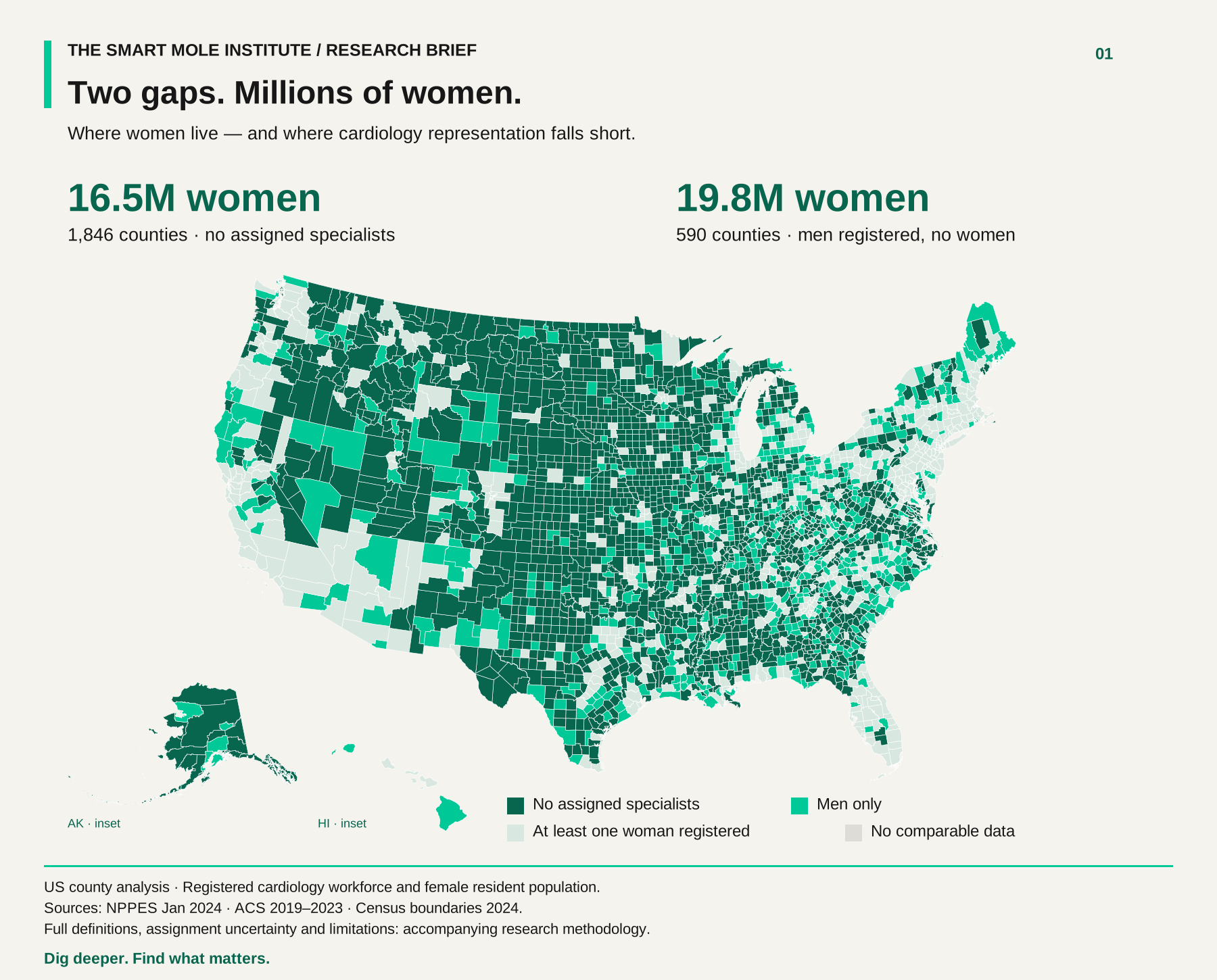
Two gaps. Millions of women.
Approximately 16.5 million female residents live in 1,846 counties without an assigned registered specialist in the cardiology taxonomy scope analysed. A further 19.8 million live in 590 counties with registered male cardiologists but no registered female cardiologists.
These two geographic gaps describe different challenges: the distribution of registered specialists and the representation of women within that workforce.
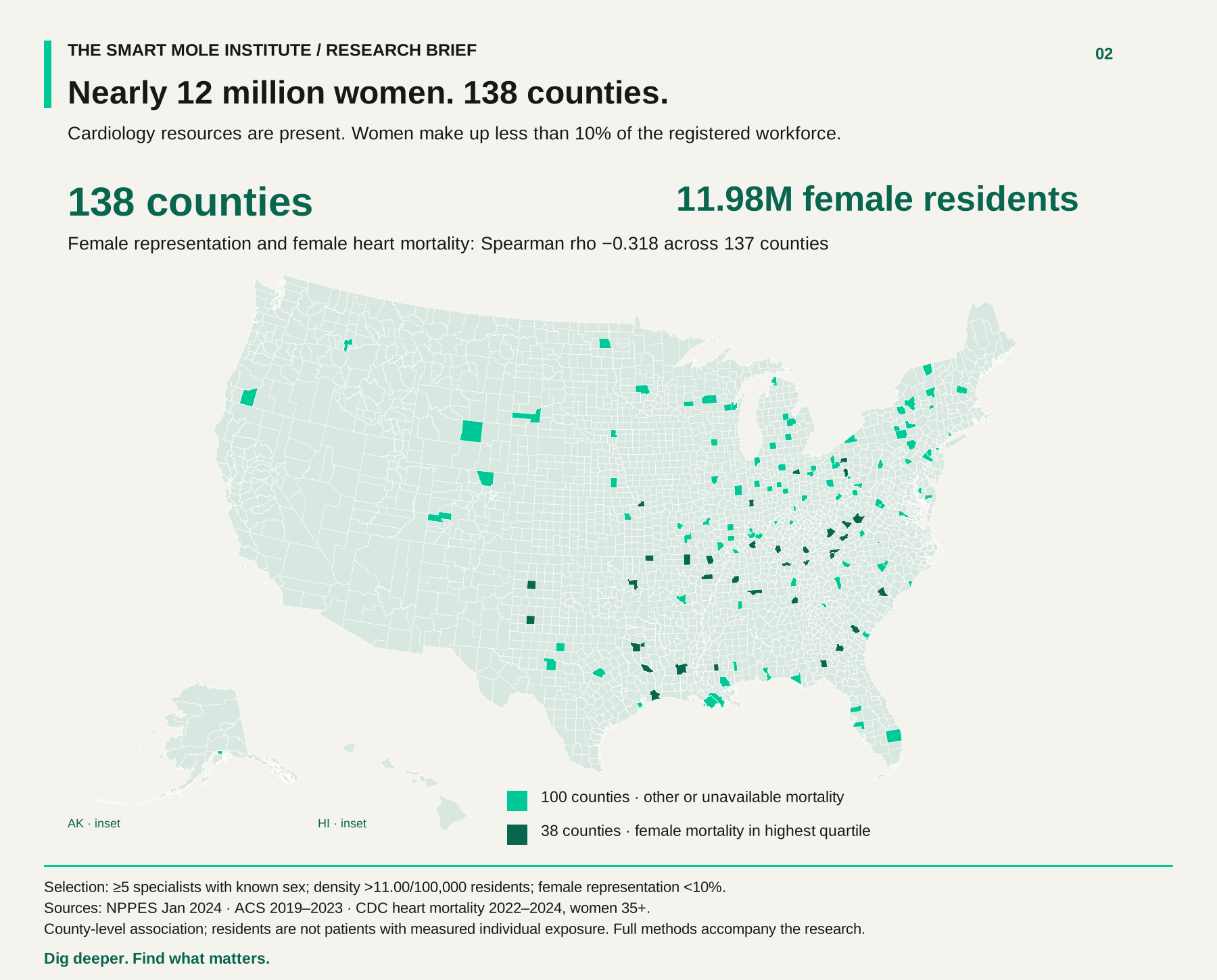
Nearly 12 million women. 138 counties.
Within the workforce landscape, 138 counties combine at least five registered specialists with known sex, higher specialist density and female representation below 10%. Together they contain approximately 11.98 million female residents. Female heart mortality is available for 137 of these counties; the female-to-male cardiologist ratio correlates with mortality at rho −0.318 within this group.
Of these 138 counties, 38 also have female heart mortality in the highest quartile of valid county rates. They are a subset meeting an additional outcome criterion, not the only counties where an association exists. The map distinguishes the wider workforce context from this higher-mortality subset.
Looking beyond the national average
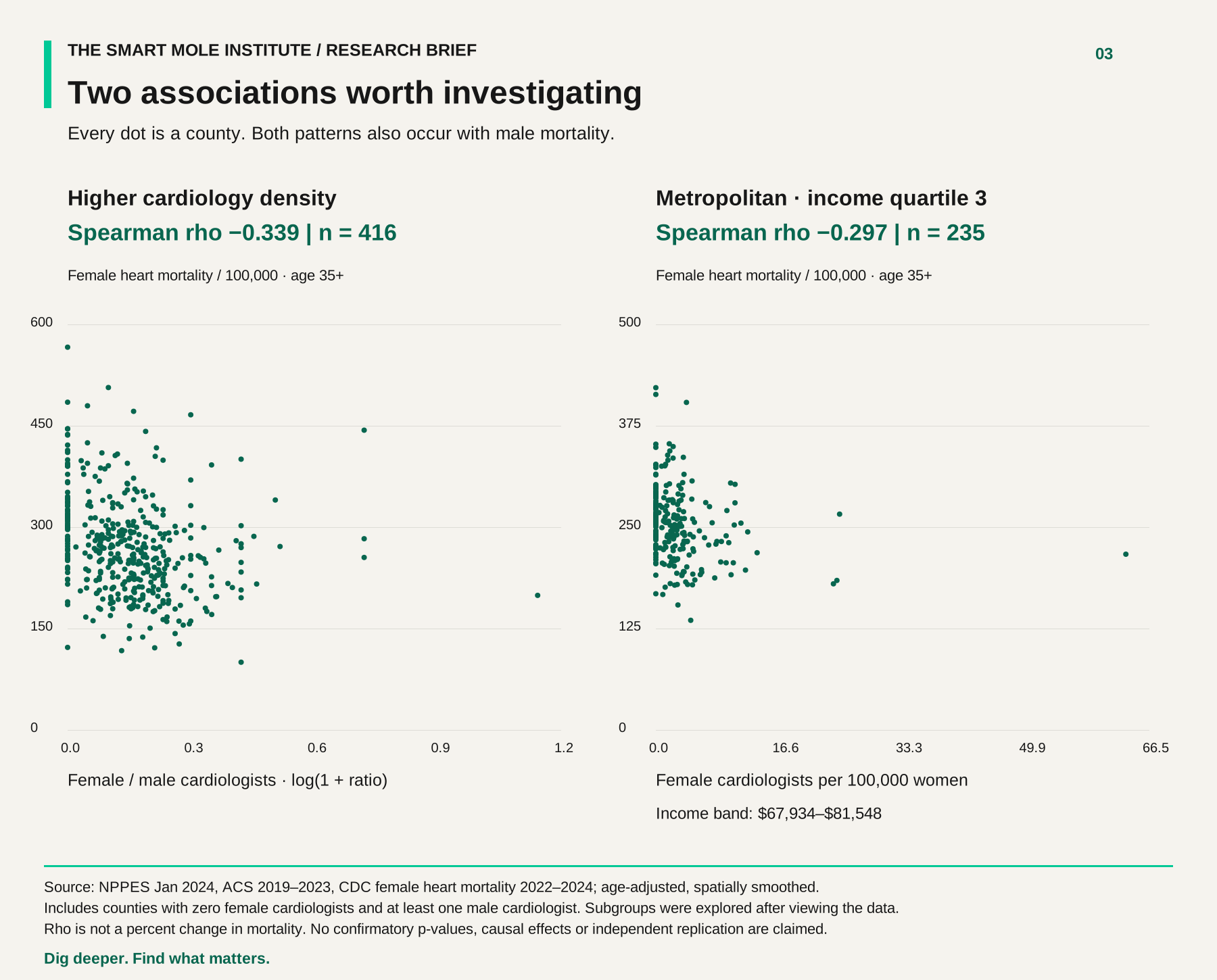
Across 1,255 counties with at least one registered male cardiologist and available female mortality data, the female-to-male cardiologist ratio correlates inversely with female heart-disease mortality (Spearman rho −0.271). Counties with zero female cardiologists remain in the analysis with a ratio of zero.
Among 416 counties in the higher cardiology-density group, the association is stronger: rho −0.339. Among 235 metropolitan counties in the third quartile of median household income, female cardiologists per 100,000 female residents correlate with female mortality at rho −0.297. Conditioning on income within this latter group yields a partial rank correlation of −0.296.
These are meaningful descriptive patterns to investigate, not estimates of how much mortality would fall following a workforce intervention. The selected subgroup correlations are of moderate magnitude; rho is neither a relative risk nor a percentage reduction in mortality. The two subgroup results overlap the national analysis and do not constitute independent replications.
Why this matters
National averages can conceal substantial variation in where specialists are registered and how women are represented. Mapping that landscape alongside women's heart mortality provides a starting point for examining service organisation, prevention, diagnostic pathways and continuity of care. The next question is which features of local care account for these patterns, and which changes could improve outcomes.
03 / METHODOLOGY
How we investigated
This ecological analysis combines NPPES January 2024 registered specialist addresses, ACS 2019–2023 population and socioeconomic estimates, and CDC female heart-disease mortality for 2022–2024. Mortality concerns women aged 35 and older and is age-adjusted and spatially smoothed. Registered sex is used for workforce categories. The outcome covers heart disease, not the full cardiovascular disease category.
The higher-density group is above 11.0011835756 registered specialists per 100,000 residents, the upper-tertile cut among counties with registered male cardiologists. The third income quartile is defined using cuts of approximately $67,934 and $81,548, with exact boundaries retained in the analysis files. These are county household medians, not individual women's incomes.
04 / LIMITATIONS
Interpreting the findings
Subgroups and exposures were explored across many combinations. The reported correlations were selected after this exploration; no confirmatory p-values or independent validation are claimed. Spatial dependence and source uncertainty further limit inference. Correlations attenuate under several contextual adjustments. Clinical-risk adjustments are sensitivity analyses: these variables may reflect antecedent risk, care pathways or both; the available timing does not identify their causal role.
Similar correlations are present with male mortality: in the 416 higher-density counties, the female/male cardiologist ratio correlates −0.341 with male mortality, versus −0.339 with female mortality. In the 235 metropolitan third-income-quartile counties, female cardiologist density per female resident population correlates approximately −0.280 with male mortality, versus −0.297 with female mortality. Thus, the ecological results do not establish a women-specific mechanism or independent reinforcement of the patient-level finding. They may reflect broader territorial conditions or shared features of care.
Resident counts are not counts of heart-disease patients. A registered address does not establish active clinical practice, available appointments or the treating physician for any resident; patients can receive care outside their county. Of 36,976 assigned providers, 433 county assignments are provisional; specialist presence in 22 counties depends solely on those assignments. ACS uncertainty is not propagated in resident totals.
The 38-county shortlist is shown as a subset of the 138-county workforce group. It identifies coexistence of four operational criteria, not the only counties with an association or the fraction of counties where an effect exists. It does not establish that the nearly 12 million residents have increased individual risk caused by workforce composition.
05 / CONCLUSION
Representation belongs in the heart-health conversation.
Cardiology resources and female representation are unevenly distributed across the United States. Nearly 12 million women live in 138 counties combining higher registered cardiology density with female representation below 10%. Within this group, greater female-to-male cardiologist representation is associated with lower female heart-disease mortality (ρ = −0.318).
These territorial patterns make workforce composition a question worth investigating alongside access, prevention and continuity of care. The map provides a practical starting point for local investigation and collaboration. Similar associations with male mortality point to a wider territorial context; the findings do not isolate a women-specific or causal effect.
06 / SOURCES
Sources and clinical context
Clinical reference: Greenwood, Carnahan and Huang. PNAS (2018).
Sources: NPPES archive, January 2024; ACS; CDC mortality data; Census boundaries. Detailed selection, sensitivities and assignment limitations accompany the integrated research outputs.
07 / CITE & DOWNLOAD
Open data and citation
County aggregates, article text and reproducible subgroup summaries. Preserve five-digit FIPS codes when importing the CSV. Blank mortality values mean unavailable, not zero.
- County dataset (CSV)
- Full article and methodology (Markdown)
- Subgroup results (JSON)
- Workforce totals and reference-only sensitivities (JSON)
- Citation (TXT)
The Smart Mole Institute. Women's heart health: does the geography of cardiology representation matter? Open research brief 001. Version 1.0. 10 October 2026. Ecological exploratory analysis; not peer reviewed. Data: NPPES January 2024; ACS 2019–2023; CDC heart mortality 2022–2024.
08 / CONTINUE THE CONVERSATION
What should we
investigate next?
Share a question, suggest a correction, or explore collaboration on women's cardiovascular health.
Contact the Institute ↗